Castle Hill is the strongest single page in Lost Dunoon. It is the point where Dunoon’s medieval, residential, leisure and wartime stories stack on top of one another. The problem is that most of that history is no longer plainly visible on the ground.
Historic image gallery
These are orientation images for the site: enough to fix the landscape in the mind and show why map comparison matters here.


What it was
Castle Hill was the original centre of authority in Dunoon. From at least the medieval period it held a defensive site associated with Dunoon Castle, later residential occupation, and eventually the more formal landscape created by Castle House. It was not just a castle. It was a fortified landscape with settlement, routes, working ground and later civic reuse.
What was lost
Almost everything that made Castle Hill easy to read as a historic site has been stripped away, buried, softened or replaced:
- the visible castle fabric
- supporting structures and settlement traces
- Black Street cottages displaced for Castle House
- Victorian leisure layers in Castle Gardens
- parts of the wartime story now reduced to hints and memories
The hill’s history has not vanished completely. It has been overwritten.
What remains now
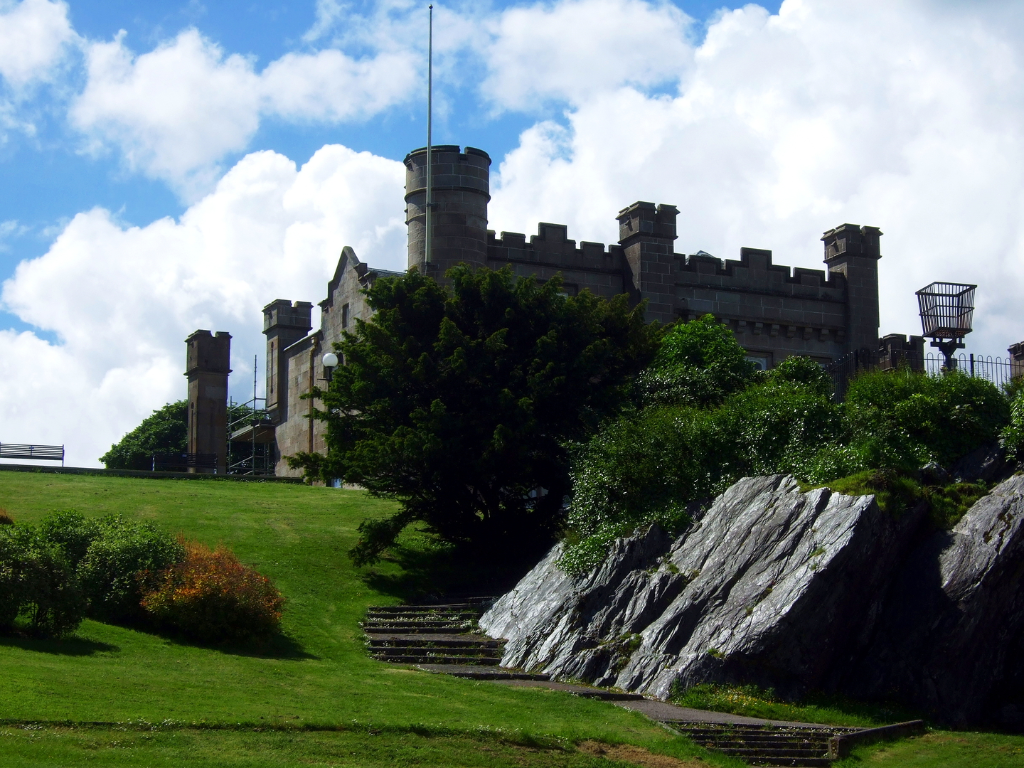
Castle House and the museum setting remain the clearest fixed elements. Beyond that, the surviving evidence is quieter: slopes, paths, altered ground, fragmentary archaeology and the way the hill still dominates the shore. The value of the site is no longer in standing structures alone. It is in the stacked logic of the place.
Then / Now compare
Fortified and inhabited
Read Castle Hill as a working, defended and occupied landscape rather than a single monument. Historic maps and archaeological notes are more useful here than a single postcard view.
Parkland over archaeology
The modern scene is calmer and cleaner than the history beneath it. Use council layers and title mapping to understand edges, routes and the hill’s later remodelling.
Layered history
Why it matters
Castle Hill is where Lost Dunoon becomes more than nostalgia. It shows that Dunoon is not only a place of single lost buildings. It is a place where one era repeatedly built over the last. That makes Castle Hill the clearest example of layered erasure in the town.